IBM Design for AI
How do you build a design discipline for something nobody knows how to design yet?
It started as a casual conversation. Phil Gilbert, then General Manager of IBM Design, and I were lamenting the same problem: nobody was getting Watson right from a user experience perspective. It showed up in different ways and different forms, none of it cohesive, none of it particularly easy to follow or understand. Somewhere in one of those conversations, offhandedly, I said somebody should dedicate all of their time to this. Not Watson as a technology. What it means to understand AI as a designer, and how to design for it properly.
Then I went through the Distinguished Designer vetting process: a full portfolio and a 25-page written record of everything I’d done, judged and decided outside the design organization by reviewers who owed me nothing. Make it through and you’re handed a mission. In 2016 IBM appointed its first three Distinguished Designers, and I was one of them. Mine came back carrying my own mission: define what it means to design for artificial intelligence, and what it means to be a designer designing for it. Full stop. No Watson. No specific technology.
The price was my team. I gave up 19 people to become a team of one, because the real assignment wasn’t a product. It was a population: 3,000+ designers across IBM who needed to take what I learned and run it through their own judgment, tooling, and products. Years before anyone said “LLM,” the job was to raise the collective tide.
What nobody was writing down
Most cases end in something you can point at. A product, a system, a room. This one ends in people: a population of designers who didn’t need me anymore.
In 2016, five years after Watson won Jeopardy, “cognitive” (IBM’s term at the time for AI) was on every IBM roadmap. What wasn’t on any roadmap was what these systems owed the people using them.
No language
Cognitive, AI, machine learning. Three names for the same thing in the same meeting, and nobody could say what any of them should feel like to sit across from.
Broken habits
Enterprise software design had spent 40 years on a quiet promise: same input, same output. Probabilistic systems ended that promise.
No practice
The ethics conversation lived in research papers and keynotes. Nothing existed for the designer starting a project on a Tuesday morning.
A title, a sentence, and nothing to inherit
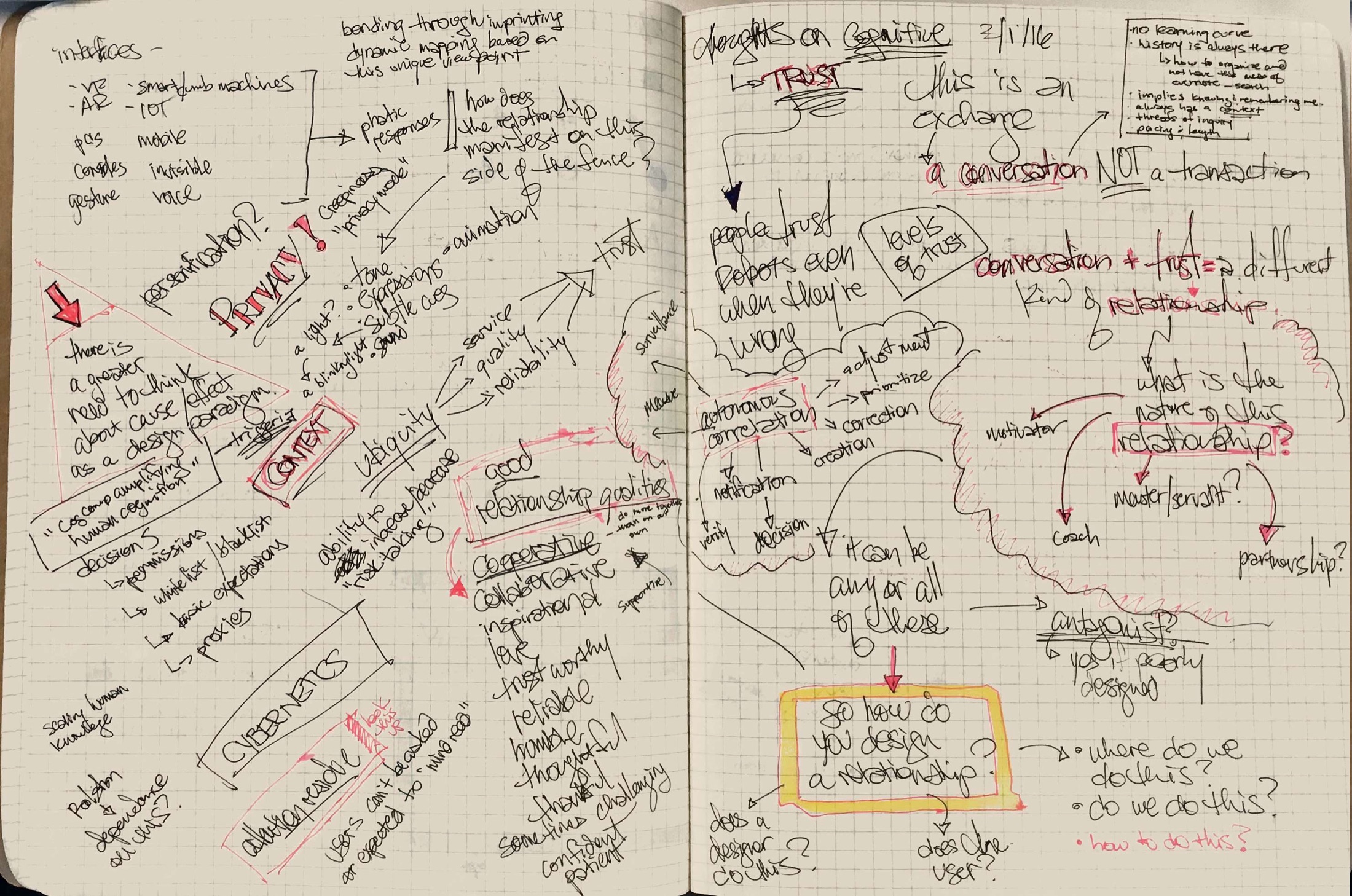
The first stretch was lonely. I’m a super collaborative person, and suddenly there was nobody to go on the journey with. A typical week was utter learning mode: talking to IBM Fellows and Distinguished Engineers, to anyone inside or outside the company who would take the call, reading research papers and magazine pieces, trying to understand the limitations and the possibilities. It wasn’t about making. And while everybody else looked at this technology as a raw set of capabilities, I kept asking the other question: what are the human impacts? What are the downstream consequences of pointing AI at a business problem, and what does it do, psychologically, to the person using it to get an answer?
Nobody had to tell me that walking away from a team to figure out what AI means was a risk. It didn’t matter. This was a mission, a duty, a responsibility. One of my true skills is being handed a problem space with no precedent, pulling out the machete, and hacking a path through the bamboo for everybody else to follow. That was design thinking. That was the design language. Now it was this: bringing understanding and clarity where there was none.
Principles · 2016–2017
I started by writing down what didn’t exist. Defining Cognitive Design, October 2016, version 0.4. 26 pages, released deliberately unfinished, with an open invitation to break it and send back the pieces. It even shipped with my notes-to-self still in the margins, in caps, because waiting for a polished document meant waiting another year the company didn’t have.
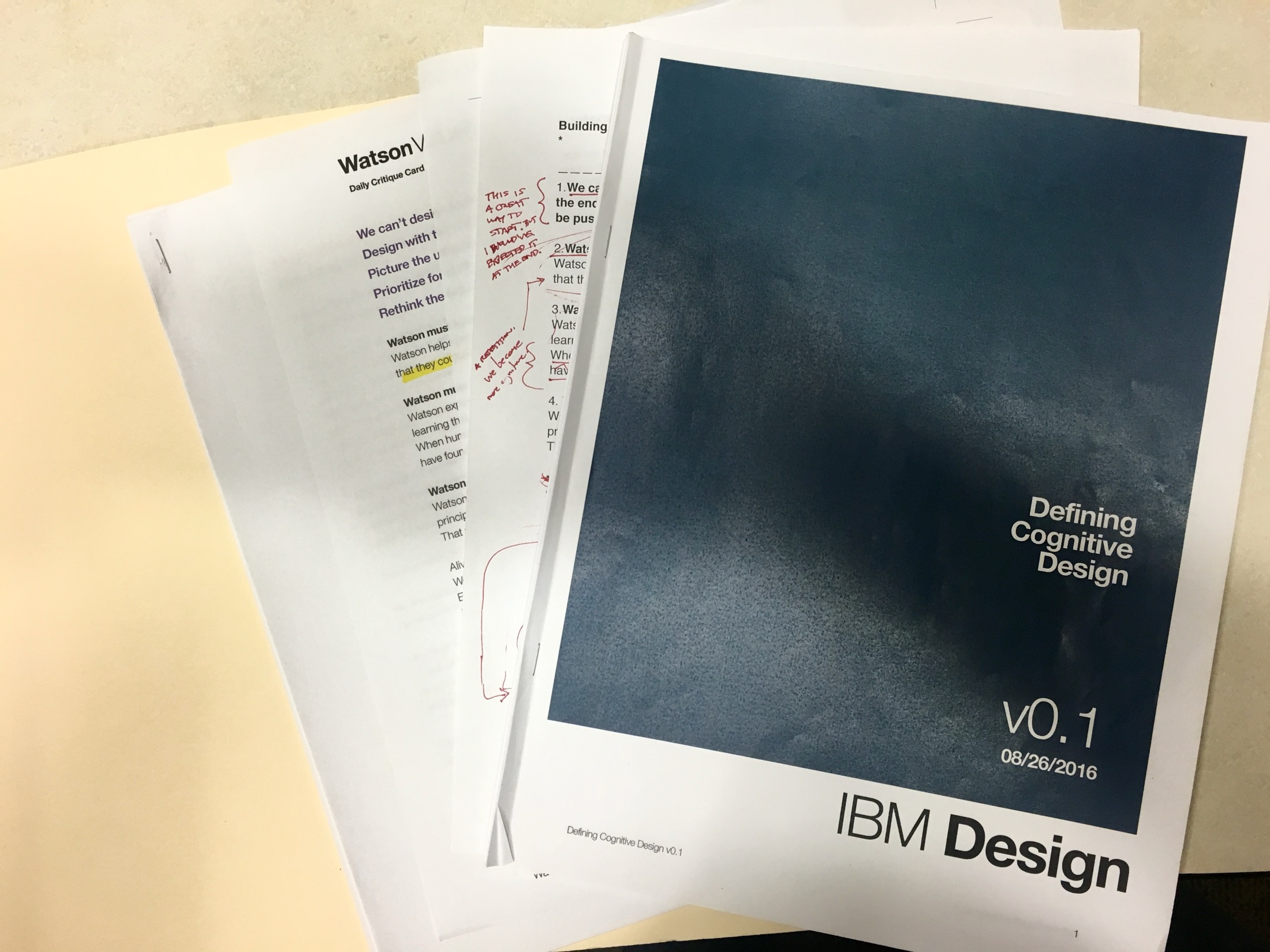
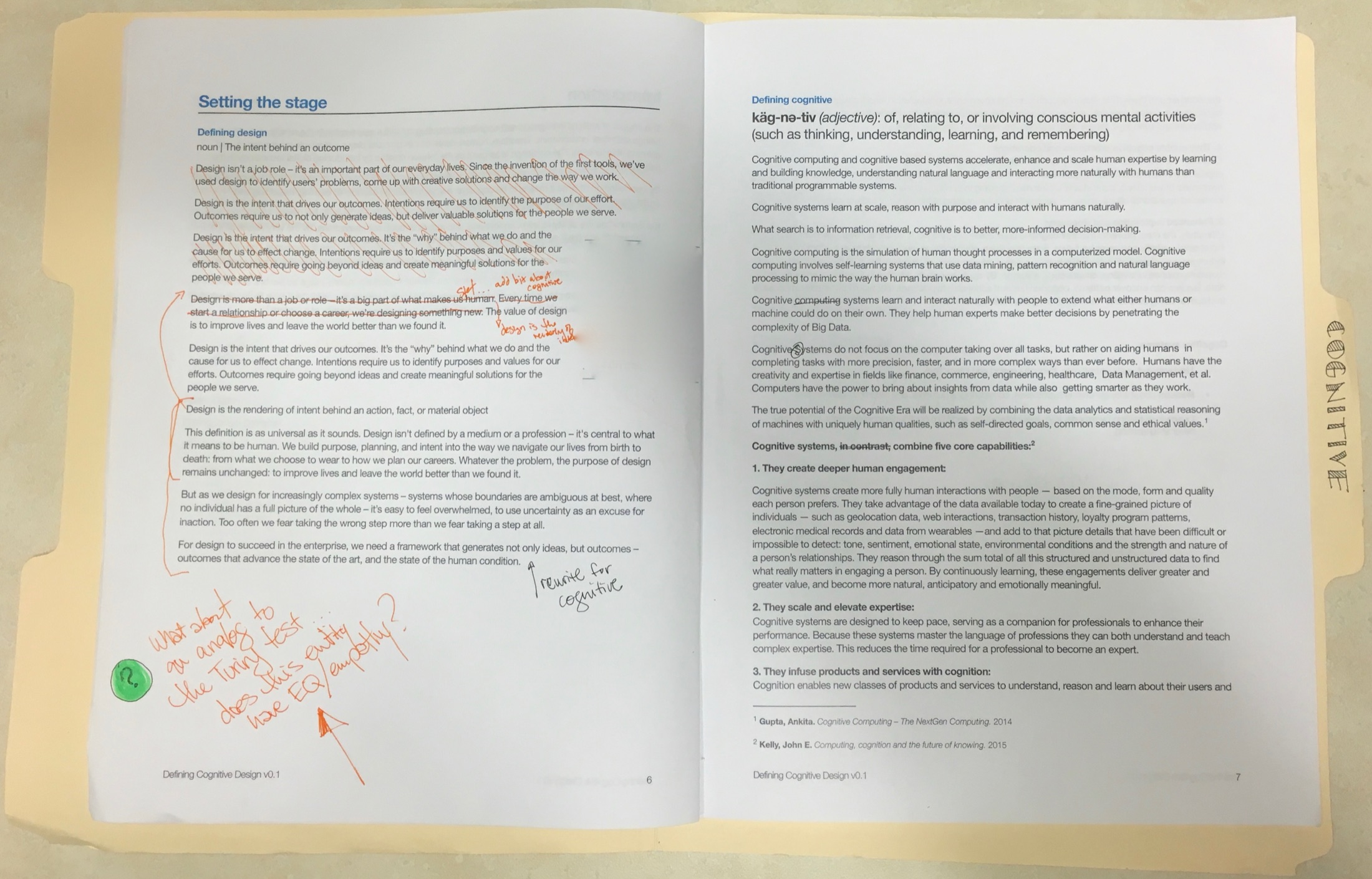
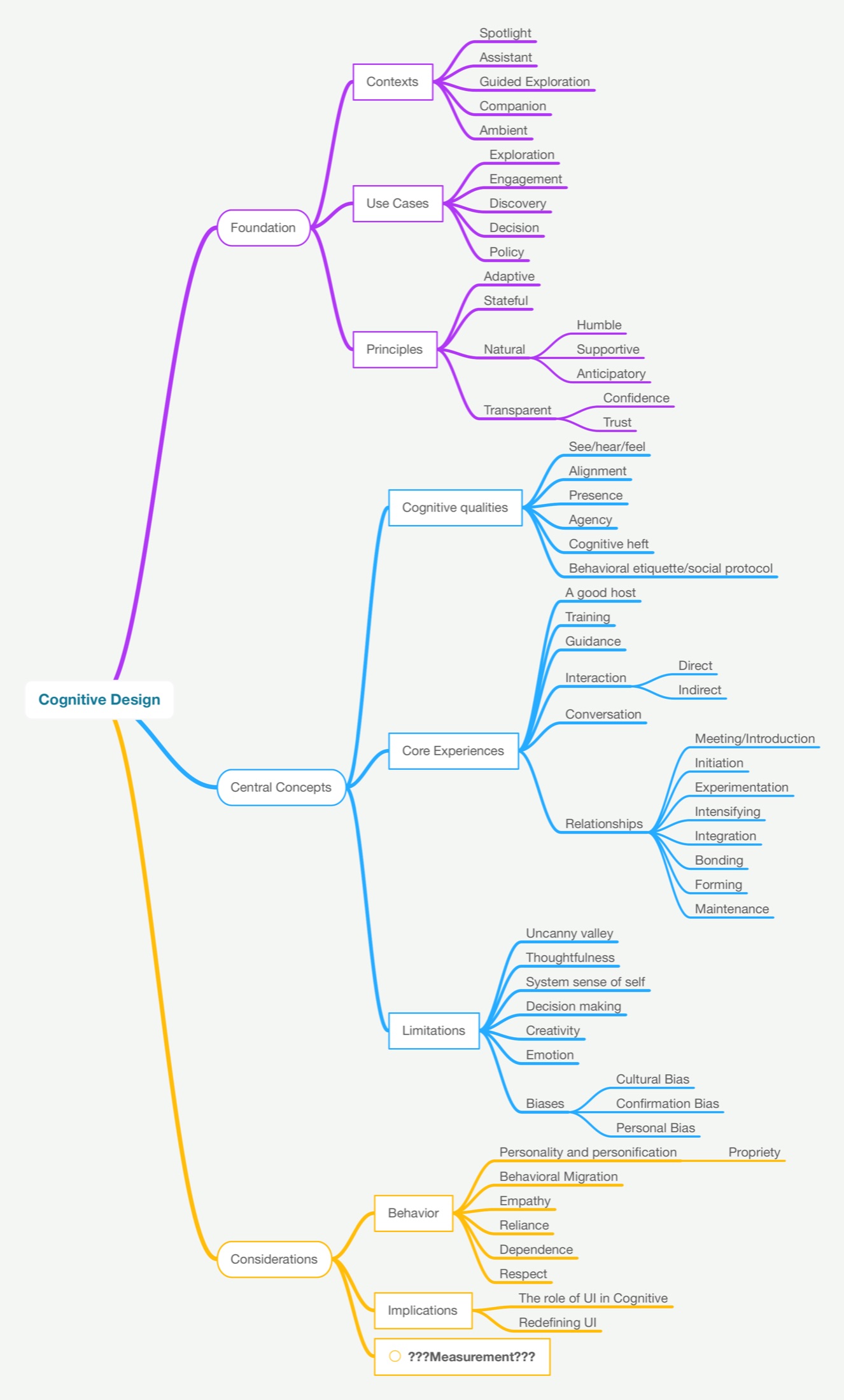
What was actually in it was a definition to stand on: design is the purpose, planning, and intention behind an action, and cognitive design is that intent applied to simulated thought processes. Underneath everything is this: if a system can understand, reason, learn, and interact, computing stops being transactional and becomes a relationship, so the discipline should be built the way relationships are. I still compress that concept into one sentence on stages: we’re entering the relationship era of computing.
A working taxonomy of the roles an AI can play, which I called contexts: spotlight, assistant, coach, companion, ambient. A set of traits a system had to earn: adaptive, stateful, natural, transparent, with humility written into “natural” on purpose, because a system that makes a person feel stupid has already failed.
A borrowed standard of conduct: the machine as a good host (taken from Eames, who took it from Saarinen), all of whose energy goes into anticipating the needs of guests. And a structure for the relationship itself, mapped onto Knapp’s model of how strangers become intimates, each stage with its own design move, except the last. At bonding, the slide just said three question marks, because I refused to pretend we knew.
By 2017 that document had hardened into teachable material. Three principles IBM still recites: augment human intelligence rather than replace it. Earn confidence through transparency. Know enough about people to hold up your end of a relationship. Purpose, value, trust as the foundation sequence, in that order, because trust is earned last. Each word carried a working definition, because a sequence you can’t define is a slogan. Purpose: the reason for a person to engage with the system at all, and it shifts as the user and system learn from each other. Value: what the system provides that tangibly improves their life. Trust: the willingness of a user to place their confidence in the efficacy of the system.
There was one diagram that did years of work: starting out as the overly complicated AI/Human Context Model, it evolved into the AI Ecosystem model. For the most part, when people talk about AI, it’s framed solely on the machine itself or the representative technology. In reality, to be able to do its job properly, the machine needs to be considered within an ecosystem in which:
- the world is represented by the data we have access to and the policies that bind it,
- the business is represented by the organization’s needs and
- the human is represented by their unique needs and the problems they need solved.
Then the machine: what it can work with is a function of those three. The context among these four elements provides the heart and soul of an AI’s capabilities. Without this context, AI is an empty vessel that doesn’t serve a genuine purpose.
Helping people to understand this relationship made a vast difference in how teams approached their work.
Getting the message out was its own design problem. One person can’t hand a document to 3,000 designers, so it moved through every channel that touched them: PDFs published into Box folders, servers, and internal pages where designers congregated, Slack, and a run of roadshows through the design studios in Austin, New York, Böblingen, Boston, and Dublin. Phil talked about the mission at campfires and all-hands town halls.
What came back surprised me: almost nothing broke. There was no precedent, so there was nothing for anyone to stand on and argue back with. By and large, people took it like a glass of water in the desert. Even if it wasn’t 100% correct, even with the ground shifting under our feet perpetually, it was something in place of nothing.
The fundamentals went public at ibm.com/design/ai, where they still live.
Ethics · 2018–2019
Ethics almost wasn’t mine, and it definitely wasn’t something I wanted at first. In 2017, I was building the conversational craft with Zack Causey and Lawrence Humphrey when Zack, who had been digging into the beginnings of something ethics-related, left the company and left the question wide open. People kept asking when I would take it on. My answer never changed: I know nothing about ethics. I’m not an ethicist, and I shouldn’t be relied on for something I don’t understand.
Milena Pribić, then designing on the Watson Education team, heard Zack had left and asked me who was working on AI ethics at IBM. Not me, I told her. The person who owned it was Francesca Rossi, IBM Fellow and Global Leader for Responsible AI and AI Governance. She thanked me and 30 minutes later there was a meeting on my calendar for the three of us, which Milena had thoughtfully arranged. Then she moved into Zack’s desk.
In that meeting Francesca surprised us: the designer’s point of view, she said, was severely lacking from the whole ethics exchange. She challenged us to write a manifesto of sorts, what designers needed to be mindful of to get people practicing ethically. I told her I didn’t know what I was talking about. That’s actually not a bad thing, she said. Go with your gut, bring it back, and I’ll teach you in the moment, based on where your intuition leads.
Around then, Stack Overflow surveyed developers and nearly half said the humans building AI are responsible for its ramifications. Not the bosses. Not the middle managers. The people with their hands on it. Those people had no tools.
So with Milena and Lawrence, I co-wrote Everyday Ethics for AI, IBM’s first practical AI ethics guidance for product teams. Five practices, each with a one-line spine.
- Accountability: every person involved in the creation of AI, at any step, is accountable for considering its impact in the world.
- Value alignment: design to the norms and values of your user group, not your own.
- Fairness: minimize bias and design for inclusive representation.
- Explainability: humans should be able to perceive, detect, and understand how the system decides.
- User data rights: protect the data and preserve the user’s control over it.
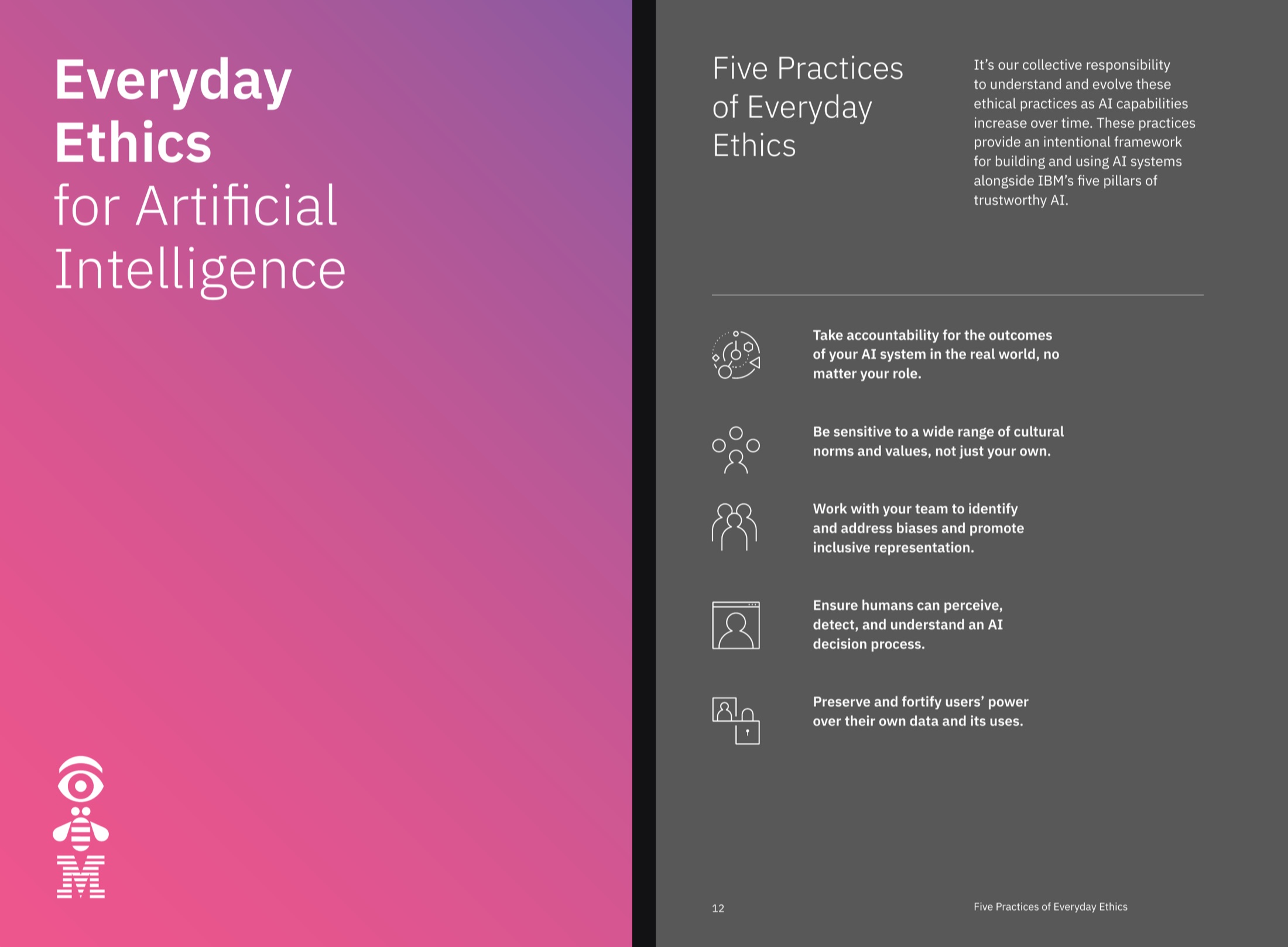
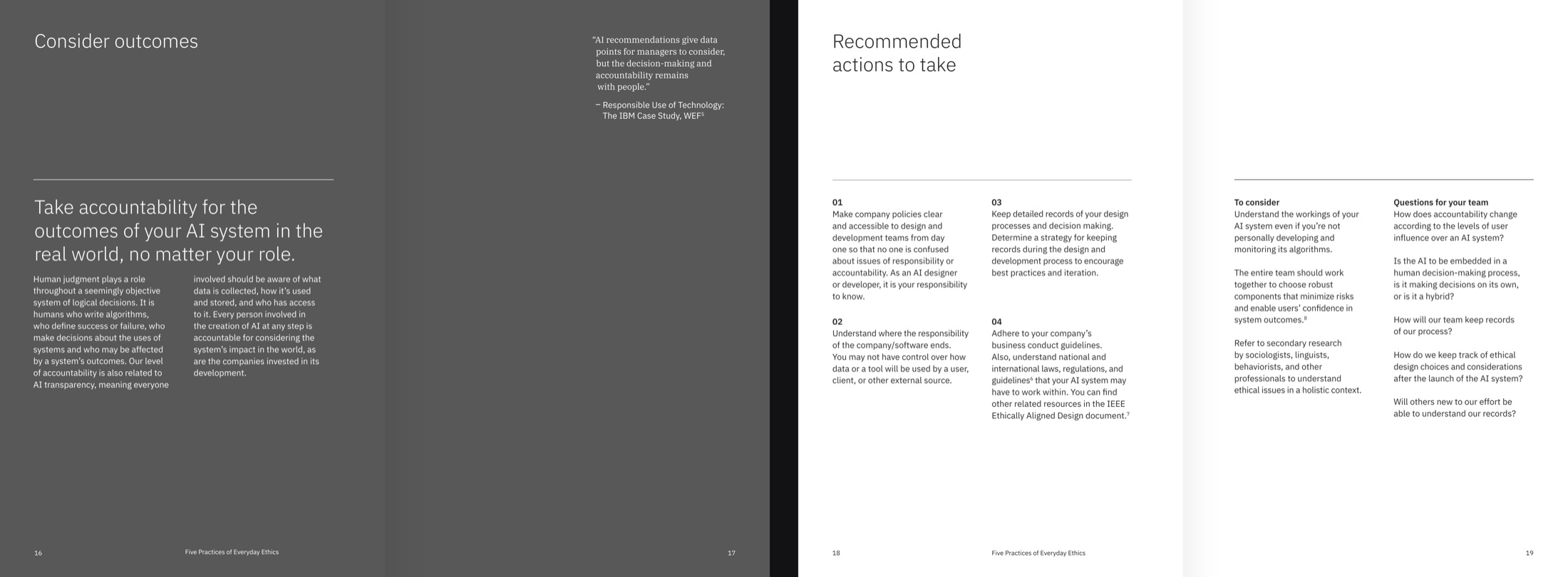
The structure was the innovation as much as the content. Each practice came in four parts: what it means, recommended actions to take, secondary research to consider, and questions to ask your team, so a lead could run any area as a working session instead of a lecture.
One running example threaded the whole guide, a hotel chain building an AI concierge into its rooms, and it kept the abstractions honest: the team interviews real guests face to face, implements a feedback learning loop when the assistant misses, and gives every guest the ability to shut the AI off for their entire stay. The guide pointed forward too, to AI FactSheets out of IBM Research, the nutrition-label idea that later became the factsheet link inside every Carbon for AI explainability popover.
Then I carried it to every stage that would have me: O’Reilly AI in 2018, THINK in 2019, Cannes Lions and AI Day in New Zealand the same year, with two companion arguments. More data was coming with less trust attached, so trustworthiness and trust are different jobs: one is engineering, the other is earned. And trust itself has anatomy, four parts borrowed from Graham Dietz and Deanne Den Hartog’s trust research: ability, benevolence, integrity, predictability. Machines could demonstrate the first and the last. The middle two were on us.
The guide traveled further than any stage. IBM published it free at ibm.biz/everydayethics, among the company’s first externally published works on ethical AI, and it opened the door to the IEEE. Milena and I went on to co-chair the committee behind Ethically Aligned Design for Business, the IEEE Global Initiative’s call to action for companies using AI, alongside members from LEGO, Microsoft, and BP, among others. It told businesses how to build a culture of AI ethics, what skills to hire for, and where they stood on a readiness scale from lagging to leading.
People & method · 2020–2022
If the practice was going to outlive its authors, it needed members. The scaling came in three shapes: a workshop, a guild, and a method.
The workshop. By 2020 the basics were packaged as Team Essentials for AI, a facilitated workshop with a badge behind it. It taught whole product teams the ecosystem model and the purpose-value-trust sequence. Start small and be bold. Don’t think of AI as magic. Consider whether you should, even if you could.
The prep itself eventually compressed into a kitchen metaphor: mise en place. Understand the business need before you start, because “the boss is hot for AI” isn’t a good intent.
- Align the whole team on a well-articulated intent.
- Get acquainted with your data and what it actually represents.
- Get comfortable with hyper-personalization right away.
- And pre-arrange the regular ethics discussions instead of hoping they happen.
The workshop leaned on one table I’d been drawing for years: humans are good at intuition, emotional judgment, common sense, and creativity. Machines are good at probabilities, volume, repetition, and staying objective. Each is bad at the other’s list. Design the seam accordingly.
The guild. The guild started as an open-ended ask from Phil: go work with the AI Apps team. I asked what I should focus on and he said, I don’t know... figure it out with them. See what they need, go deep, so this stops being theoretical and starts applying to real business problems.
Hal Wuertz and I figured it out together, and her recommendation was the shape that stuck: a small guild of the designers already assigned to AI-infused products in that portfolio. In 2021 we founded it with around two dozen volunteers. Four hours a week. No budget line.
I remember the first plenary. Everybody was awfully quiet and unsure of themselves. These were people who had been working in the space for a while, and nobody had strong opinions yet. They were applying the same UX skills they’d honed on deterministic software to probabilistic systems. So we started with the humblest project on the list: a glossary, so two teams stopped meaning different things by “model.” I knew the guild would hold at the second plenary. I’d braced for attendance to drop by half. More designers showed up instead, and people were starting to find their voice.
The mechanics were deliberately boring and deliberately durable: a roster on Airtable, a cross-workspace Slack channel, plenaries every other week with a fixed anatomy. Each plenary opened with signals, a technique borrowed from strategic foresight where a member brings something observed in the world that might mean big change, then project updates, then two 15-minute critiques where teams put unfinished work in front of the whole guild. Attendance earned learning credits, so the hours counted somewhere official. The guild even grew a service arm, Design for Good, six-week IBM Service Corps deployments where guild members ran the AI methods with nonprofits.
That first year the guild shipped six foundational projects: an AI skills ladder so managers could hire and grow AI design competence on purpose, which got instantiated into IBM’s HR taxonomy so people could be hired specifically as AI designers, an org-wide AI glossary so teams stopped using a term that meant something else depending on context, a set of AI quality heuristics for evaluating AI experiences the way Nielsen’s heuristics evaluate interfaces, a competitive analysis framework tuned for AI products, a question-based explainability workshop built with IBM Research, and the modules that became Enterprise Design Thinking for Data & AI.
The method. That last one deserves the deepest look, because it’s where the discipline got installed into how IBM already worked. With Mara Pometti, Keith Carlson, and Milena Pribić, I took the method I’d helped scale once before and taught it to ask about data. It runs in two halves. A strategy workshop, two to three days with executives and product owners, sets the intent. A technical workshop about a week later, with the data scientists, designers, and developers, turns that intent into something buildable.
The sequence tells its own story. Set intents: business opportunity statements, a fill-in-the-blank I’ve called the offspring of Mad Libs and design thinking. Then the team picks from six AI intents: the six things this technology reliably does for a business, and writes hypotheses as bets with a price on waiting: if we knew X, we could Y, which moves this metric by this much, and every week we delay costs us Z.
From there the map decomposes into things a team can actually schedule: a to-be use case that should end up looking like a pine tree tipped on its side, then data source identification, where every information type gets traced to a named source and a named steward and colored by whether the data is proprietary, public, or the user’s own. This is the moment most AI ambitions meet their actual inventory. Then Hills written as who, what, and wow, an assumptions grid that sorts the guesses by risk, and a 30-60-90 to-do wall with an owner on every sticky.
And riding along the whole way, the ethics exercises, ready whenever the team needs them: layers of effect for forecasting primary, secondary, and tertiary consequences, an inverted behavior model that reverse-engineers BJ Fogg to predict misuse, dichotomy mapping, stakeholder maps asking explainable to whom, consideration cards, a motivation matrix, a 360 review, power mapping. Ethical decision-making moved from a review at the end to exercises inside the workshop, which was the whole point of layer two.
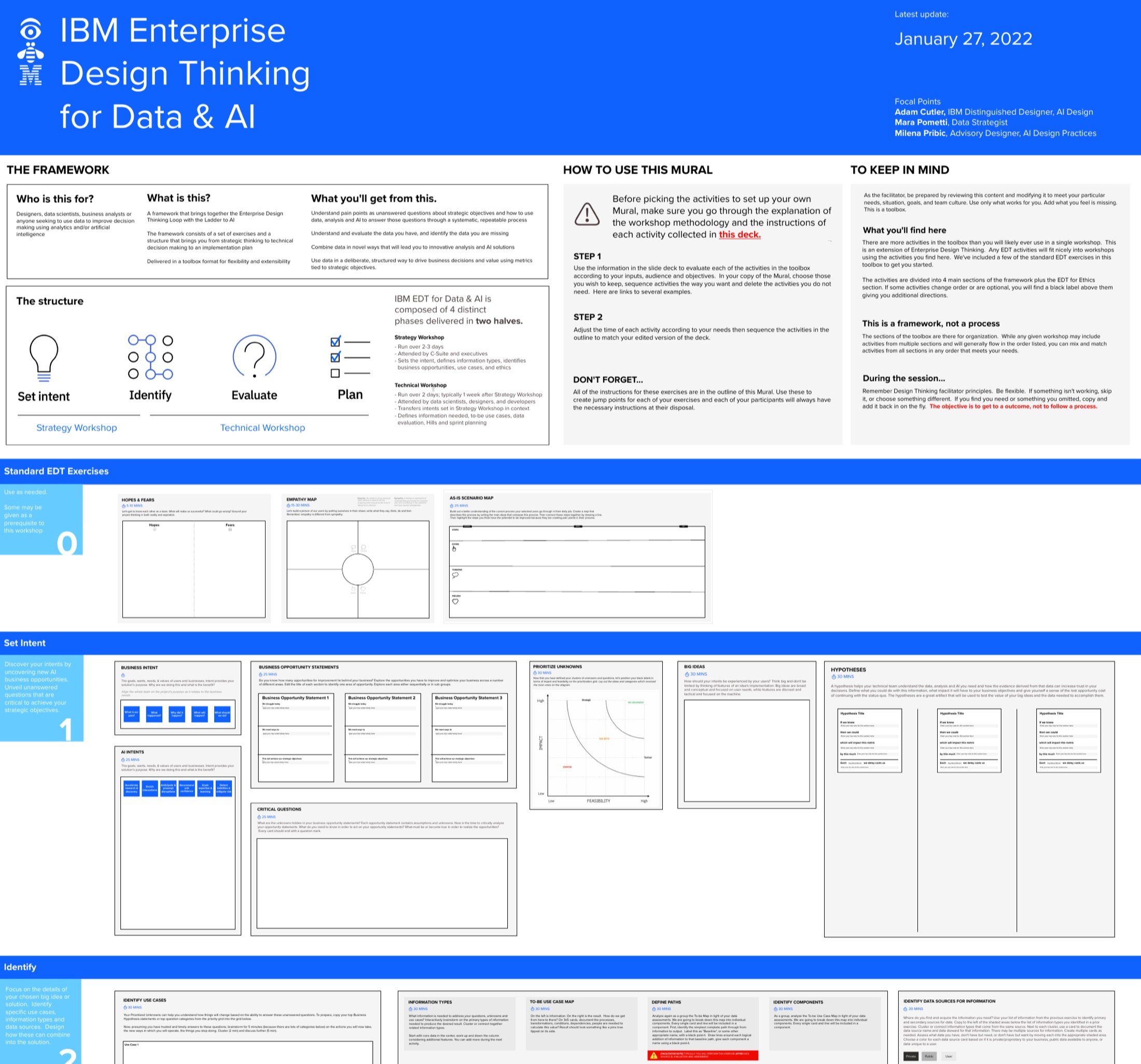
We trained coaches on it through 2022, and three years later the same template was still running inside the AI Accelerator, aligning watsonx teams before they touched a component. The projects were good enough that in 2022 the guild went company-wide. Christopher Noessel stepped up to run it, and roughly 200 new members joined from across IBM’s disciplines and geographies.
The second jump came with the wave. When Kareem Yusuf, then IBM Software’s Senior Vice President of Product Management and Growth, asked for a design language just for artificial intelligence, the guild went with it: handpicked representatives from every effort plus the volunteers who kept arriving, past 250 members, with membership coming in from IBM Consulting, Infrastructure, and the CIO’s office among others across the organization.
Craft · 2017–2023
The craft never waited its turn. It ran under every layer above, and by 2023 it had produced a shelf.
to Data Literacy, February 2023
April 2024
July 2023
Conversation. In 2017, with Zack Causey and Lawrence Humphrey, I wrote Building Conversational Agents, the first hands-on guide for the teams building on Watson Conversation. It was unglamorous on purpose: dialog architecture explained through intents (understanding what the user means) and entities (catching what they said), evaluation, jump-to logic, placeholder syntax, slots, context-aware dialog, and a closing argument called intents and entities the right way. It moved through a Slack channel and a Box folder, which was how craft traveled inside the company.
By 2019, the conversation work had grown into a design theory. Designing for Dialogue opened with a real text thread between Milena and Lawrence, then the same thread with one side deleted: this is what your bot experiences. Conversation got an anatomy: topics provide context, exchanges communicate information, utterances are the individual statements, with a taxonomy of exchanges borrowed from linguistics.
If that sounds academic, its use was blunt: most chatbots fail because their creators don’t define their purpose, set goals that are too ambitious, and launch before they’re ready. The same three failures the 2020 workshop would later teach whole teams to avoid. Eventually the practice matured into a full conversation design framework led by Bob Moore of IBM Research, built on his Natural Conversation Framework.
Explainability. The 2018 focus area grew into the guild’s most complete craft suite. In-product guidance: the AI Label as the single path in, a call-out card with a summarized local explanation one click deep, then two tearsheet variants for the full story, with a rule to use one or the other, never both. A levels model separating local explanations (why this output), global explanations (how the model works), and XAI documentation (what it was trained on and how it performs).
A self-evaluation on Airtable that scored a product’s explainability across six dimensions and returned an explainability card. An examples library, tagged and searchable by persona. A mental models activity built with IBM Research, plus a lite version, for surfacing what users actually believe the AI is doing. A UX research toolkit tuned for measuring trust and understanding.
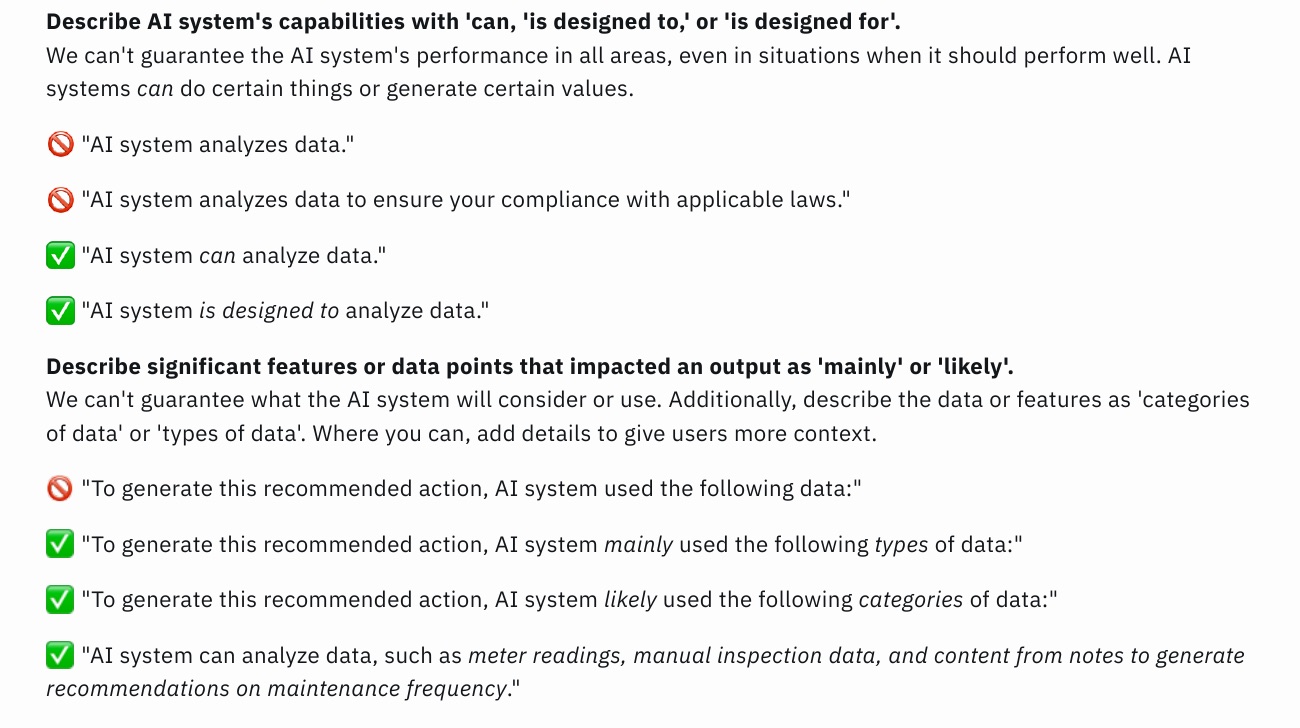
And writing guidance developed under IBM Legal’s eye, down to patterned language: say the system can or is designed to, never that it ensures. Say it mainly or likely used these types of data. Never sell.
Data literacy. In February 2023, the guild’s literacy thread produced The Friendly Guide to Data Literacy, built with Maria Sánchez Domènech and Andrea Barbarin for everyone who nods along when the word data comes up. It starts by admitting there’s no common definition of the word, then hands designers the working anatomy of data itself: its nature, format, shape, origin, provenance, and quality, with the traps named on the way, the observer effect, social desirability, the semi-structured middle where email lives.
Then five principles to keep everyone honest.
- Data is an artifact of human behavior.
- Data codifies the past, so it struggles anywhere history has no precedent.
- Data is a means to an end.
- Representative data beats big data.
- Data gets collected, used, and disposed of ethically, because we’re all accountable for this.
The 2016 document had called data the fuel and insights the destination. The guide finishes the thought: it’s not the map, it’s not the vehicle, and it can’t be an answer without the right question.
The codification. Five months later, in July 2023, ten of us from across IBM Software compiled the accumulated craft into UX for AI, 35 pages of baseline guidance with two jobs: make designers competent AI designers, and give everyone else on the team enough feel for the craft to collaborate without having to master it.
It opens where the guide left off. The systems are probabilistic now, generative variability is the design material, and data literacy is officially part of the designer’s job. Bias gets the plainest metaphor in the book: train on a single teacher with a strong accent, and you’ll speak with one too.
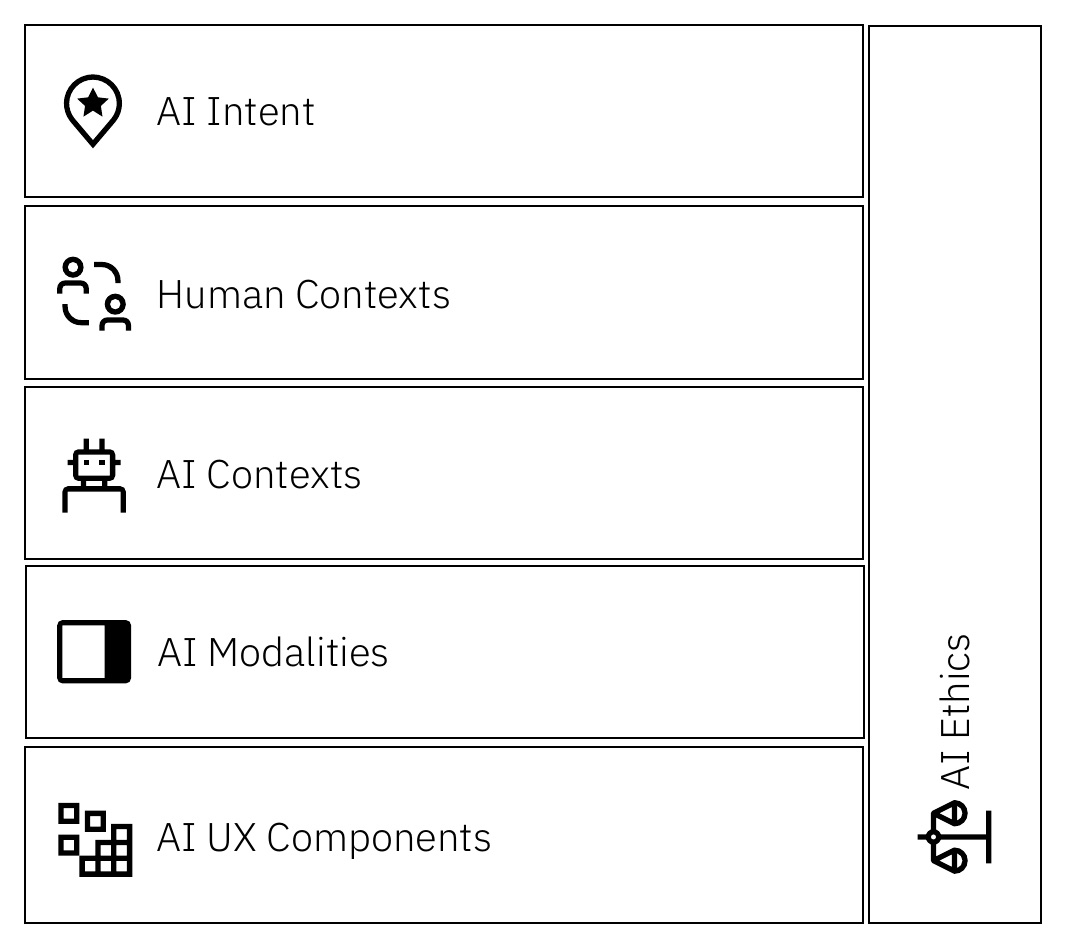
The paper defines the AI designer’s responsibilities as a triangle: people, data, systems, with a warning attached to the third: know the technology well enough to stop proposing sci-fi solutions that can’t be built. It insists on prototyping early, Wizard of Oz style if needed, LLMs making functional fakes cheap. It widens who counts as a user to four archetypes: influencers who commission the system, makers who build it, users who act on it, and affected people who never touch it but live with its decisions. And it bounds the AI modalities by rule, including one I’ll defend forever: an avatar should never attempt humanoid form. Ten principles are stated plainly, ending on the one that matters most: design for resilience, because the machine will be wrong and the experience has to survive it.
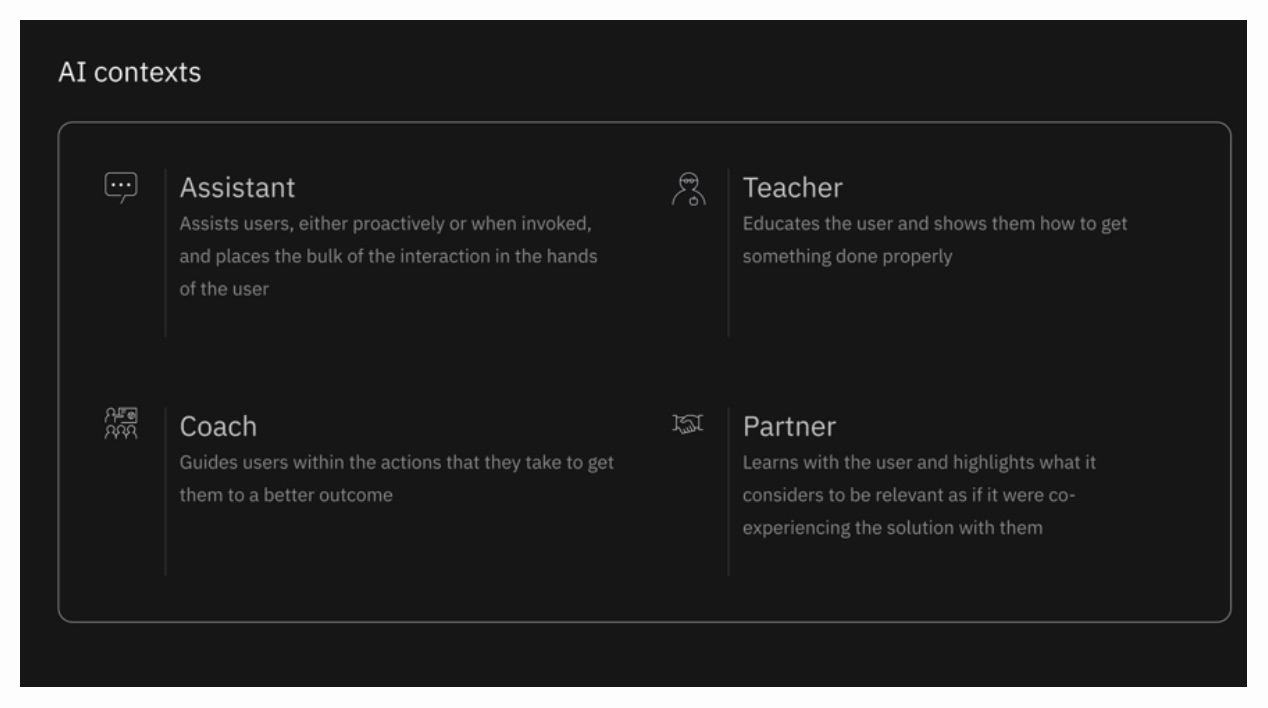
Some of it was new craft. Some of it was the 2016 document, validated. The AI contexts (assistant, coach, teacher, partner) descend directly from the ones I’d sketched seven years earlier, and the assistant’s description survives nearly word for word. Ambient is in there too, filed as a modality, waiting for its turn. The paper even asks a question I first typed in October 2016, almost verbatim: if we’ve moved past typing into a field and pressing submit, what does it mean to design what comes next? Seven years, same question, better answers.
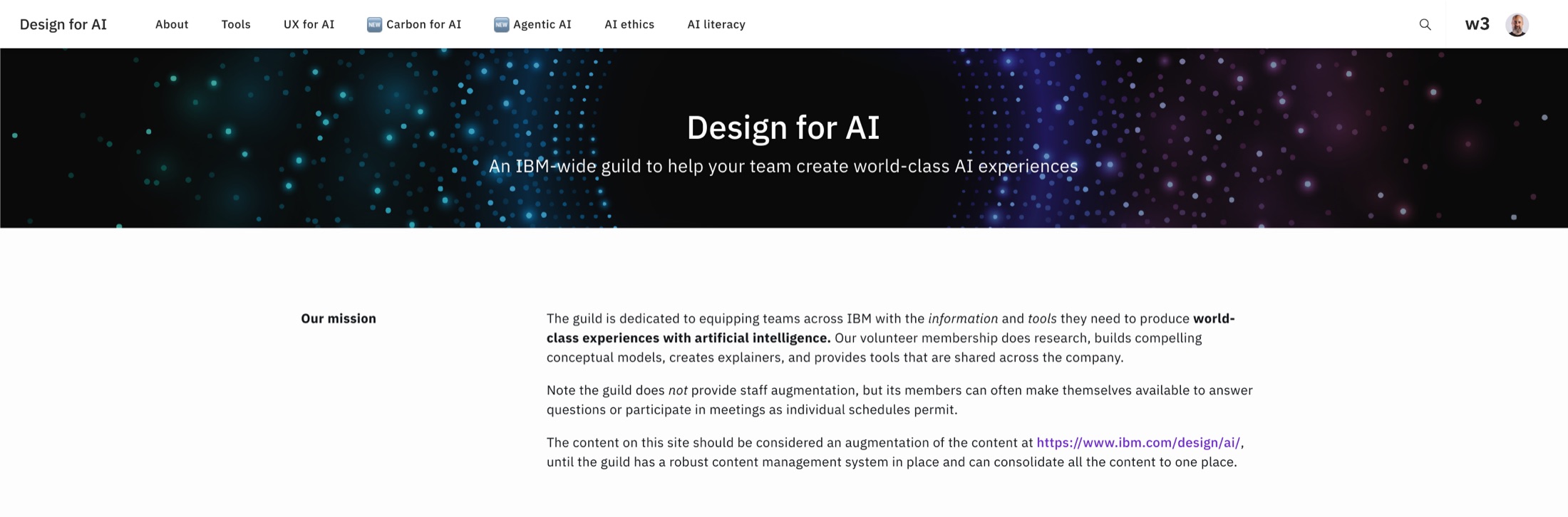
The shelf kept growing sideways into whatever the practice needed next: guidance on over-reliance and how to prevent it, accuracy testing for AI models and systems, Enterprise Design Thinking for AI Ethics, and, when agents arrived, a getting-started guide for designing for agentic AI. And by the end, the craft had a permanent address: an internal Design for AI site with wings for the guild, conversation design, ethics, and explainability, each wing with a team behind it. What began in a Slack channel and a Box folder ended as infrastructure.
Seven years, same question, better answers.
Where it landed · 2023–2025
When watsonx shipped and every IBM software team was told to embed generative AI, the discipline was sitting there, waiting. The principles became recognition standards: one universal AI Label, localized into every supported language, so anyone can tell what the machine made. The ethics practice became an explainability popover, one click from any AI output, with the factsheet idea from the 2018 guide at the bottom.
The methods became the front half of the AI Accelerator, a five-phase onramp that meets teams where they are, two weeks or six months: kickoff, then alignment through Enterprise Design Thinking for Data & AI, then learning through Carbon for AI and explainability and system prompt writing, then experimentation, then rapid co-design and prep for development. A team entering the Accelerator in 2025 was walking through the layers of this case in order, without knowing it.
The practice became patterns, and the patterns became product. That product is Carbon for AI, and it has its own case. The bridge between the two isn’t rhetorical: Carbon for AI’s guidance lived inside the Design for AI site itself, one wing over from the guild, with the chat patterns, the explainability popover, the label placement rules. Agentic AI is stress-testing all of it now, and that story belongs to Carbon too.
The last thing the corpus did was get ready to keep teaching. In May 2025 the whole site was flattened into discrete documents with one intent: eventually train a chatbot on all of this material, so the discipline stays findable by designers who never sat in a plenary and never met me. Nine years of teaching people how to sit across from a machine, ready to keep answering from inside one.
The unfinished layer · 2025
The last layer was the oldest idea in the stack. The 2016 document had named the contexts an AI could occupy: spotlight, assistant, coach, companion, ambient. Ambient meant intelligence the way a room has temperature, present everywhere, pointed at the task instead of at itself. The document guessed ambient would end up the most common form. It took nine years for the technology to catch up to the sentence.
My last work at IBM was the blueprint for that layer. Ambient Intelligence in Enterprise Software, April 2025, with a primer for the portfolio that summer. The cover line carried the thesis: we’ve taught people to adapt to software, and it’s time software returned the favor. A chat box is a vending machine for text. You put language in, it spits product out. The pocket-calculator phase of AI. Ambient is the bet on what comes after: an intelligence layer inside the work rather than a panel beside it.
The blueprint is specific about how. A six-layer stack, sensor to learning, rebuilt for the enterprise, where the sensors aren’t hardware but the digital exhaust already flowing: activity logs, system events, chat and task traffic, presence signals, performance metrics. A context layer that turns that exhaust into answers to real questions: who’s working on what, is this task critical, is a bottleneck forming.
A fusion layer that reconciles what no single system can see, like a ticket marked done with no activity behind it. A decision layer choosing the lowest-friction help. An actuation layer that nudges in Slack, re-routes tickets, reprioritizes a sprint board, holds notifications while someone is heads-down. And a learning layer watching which interventions people ignore, because ignored help is a design verdict.
The governance isn’t an appendix; every layer carries its own requirements, and the 2018 ethics practice is load-bearing all the way down. Consent to observation, with opt-ins split by data type: data about the task, data about how you do the task, data about how everyone does it together. Contestability, so a person can see and correct what the system inferred about them.
Provenance tracking on every synthesized signal. The Carbon for AI frameworks applied to every suggestion and automation. And user agency as a hard floor: accept, modify, reject, or reverse anything the system does. Frustration itself becomes telemetry, read from undo patterns and repeated navigation, which is the ethics practice grown teeth.
Underneath the whole thing sits a humane interaction grammar borrowed from Raskin: a small, universal set of verbs (find, summarize, create, adjust, delegate, notify, schedule, monitor, undo) with modifiers for time, entity, format, priority, condition, and privacy. The LLM interprets whatever a person says; the grammar normalizes it into something predictable, composable, and reversible.
Chain it and it reads like work actually sounds: find last quarter’s invoices, summarize for execs, notify the CFO. Domains get dialects, a datalake speaks ingest, catalog, validate, transform. Undo is a first-class verb everywhere, so a person can predict the machine even when the machine is busy predicting them. The paper closes on Weiser, the most profound technologies are the ones that disappear, and on a day-in-the-life of an analyst whose tools quietly triage, draft, shield her focus, and hand off her shift summary before she asks.
The limit: this layer never hit one. I left before it could. The question came with me.
What changed
A discipline has no dashboard. The only honest metric is what keeps running without you.
Everyday Ethics is still free, still cited, and still being consumed by IBM designers as talking points. The fundamentals are still public. The skills ladder still tells managers what an AI designer is. And Carbon for AI, informed by all of it, still ships. The method still onboards teams that will never know my name.
And there’s a tell I learned to enjoy: my own slides presented back to me, my key phrases used word-for-word by someone else to justify their thinking. That was the whole point.
Credits
Seven years of this belonged to many hands.
- Milena Pribić · Everyday Ethics co-author; ethical AI practices, start to finish; Ethically Aligned Design for Business co-chair, IEEE
- Lawrence Humphrey · Everyday Ethics co-author; conversational agents guides
- Zack Causey · conversational agents guides
- Francesca Rossi · IBM Fellow and Global Leader for Responsible AI and AI Governance; the challenge, and the first teacher
- Hal Wuertz · Design for AI Guild co-founder
- Christopher Noessel · guild lead, Guild 2.0
- Claudia Elbourn · guild lead, 2024 on; explainability content
- Mara Pometti & Keith Carlson · Enterprise Design Thinking for Data & AI
- Vera Liao · question-based explainability workshop, IBM Research
- Bob Moore · conversation design framework and the Natural Conversation Framework, IBM Research
- Maria Sánchez Domènech and Andrea Barbarin · The Friendly Guide to Data Literacy
- UX for AI co-authors · Dawn Ahukanna, Jillian Byra, Emily DiCesaro, Stefanie Lauria, Mayan Murray, Jason Telner, Adi Veerubhotla
- The Design for AI Guild · 250+ volunteers who did all of this on top of their day jobs
What still matters
The warning came from this era, and it was never about the machines. The 2016 document bet everything on a machine one day holding up its end of the relationship: understanding, reasoning, learning, and interacting. The 2017 conversation guides said designing those relationships requires us to consciously understand ourselves before anything else. On the TED stage I asked it as a question about friendship. By THINK 2019, it was a slide: to design for this relationship with AI, we need to know ourselves first.
There’s a distinction that keeps this case honest: designing for AI and designing with AI are different jobs. This case is the first one. The rest of my life became the second.
The thing I designed against back then, handing over the reasoning for the convenience, I now live inside, ten hours at a stretch. I wrote about what the warning means from in there: Know Yourself First.