Accelerated Visioning
How do you get better ideas by giving people less time?
Our best work came from situations where we didn’t have enough time and the stakes were high.
That’s a strange thing to admit. It means the standard way our engagements were structured, with time to spare and the stakes diffused across a methodology, was optimized against our best work.
In 2006, Jodi and I bottled the pressure on purpose. Artificial time constraints, agile concepts, and a play-infused construct, sold as an eight-week engagement. We called it Accelerated Visioning.
IBM iX sold hundreds of them. It was also something else, though we didn’t know it yet: a precursor to IBM Design Thinking.
Returning ‘play’ to the work
Accelerated Visioning is a service offering I co-created for IBM iX in 2006: a precursor of sorts to the use of design thinking inside IBM. It’s a lightweight, short-duration client engagement focused on the art of the possible and on user needs, instead of a feature-first, technology-based approach.
Eight weeks. Immersive understanding of a problem space, rapid iteration on game-changing concepts, and prototyping of the best of those ideas. At project completion, the client walks away with an interactive “concept-car” prototype, a Vision Blueprint, and an implementation roadmap. Something to feel, something to argue with, and something to fund.
The pitch for the whole thing fit in a sentence we used with clients: not having a vision is like flying a plane without radar. Innovation can’t happen without one, and everyone involved has to be able to describe it, believe it, and live it.
Losing pitches to faster agencies
Competitive digital agencies were promising more, faster, and at a lower cost. The IBM GS Method was the go-to methodology for driving engagements, perfectly suited to large-scale problems. But as the age of social computing and complex web apps was dawning, it wasn’t nimble enough to keep pace with the evolutionary change our clients were looking for.
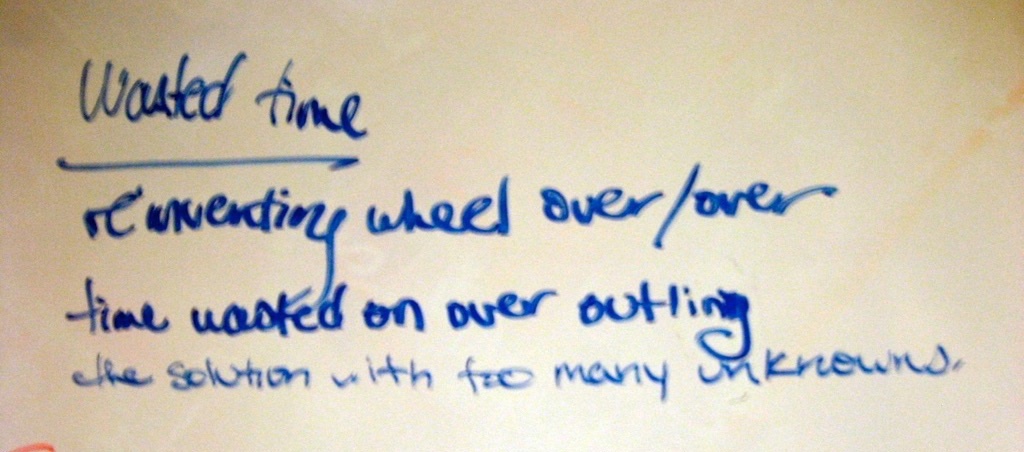
The whiteboard from that era says it honestly: wasted time reinventing the wheel over and over. Time wasted on over-outlining the solution with too many unknowns.
The diagnosis we ran on clients had five named blockers, and they still read current.
- Time. There’s never enough to ideate, implement, and do the day job.
- Operational focus. Emphasis on the day-to-day without investing in the future.
- Organizational inertia. Risk and change get managed and mitigated rather than embraced.
- Functional misalignment. Conflicting goals and metrics lead to designing for consensus, and the customer’s needs get sub-optimized.
- Defining the return. Strategic bets resist clean ROI, so they die in review.
Beneath the five sat one more line from the pitch: dogmatic reliance on methods, processes, or frameworks rarely yields successful or meaningful innovation in customer experience.
Bottling the pressure
Jodi and I were sitting at our desks one day after a post-mortem for a project where we were unhappy with the quality of the ideas as delivered to the client. We posited that a key contributing factor was the manner in which our engagements were being structured: for designers, by people who really didn’t understand design.
As we researched what drove designers and what constituted success in their view, we realized that play is an essential activity for exploring ideas that can make a difference. At the same time, I was studying the traits of our biggest successes, and discovered the pattern: our best work came from situations where we didn’t have enough time and the stakes were high.
Jodi brings a different mind to it all. Her insistence on play was critical: the two of us worked together non-stop on this, scribbling all over our shared whiteboard, drafting the original sales pitch decks, and coming up with the mechanics of how the engagement worked.
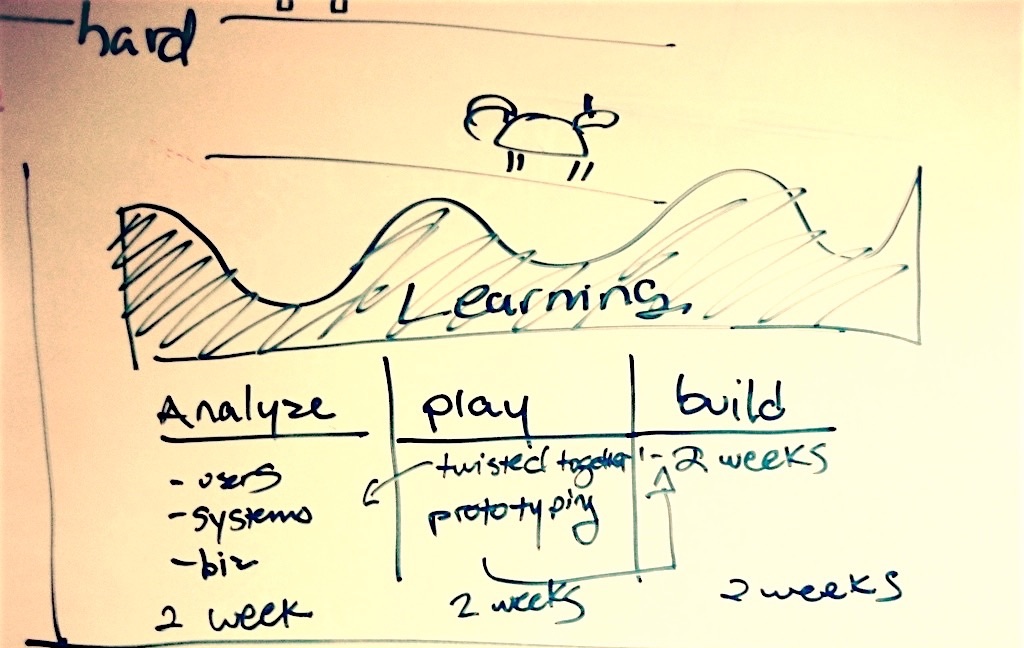
So we introduced the pressure artificially. Time boxes, agile concepts, and a play-infused construct. The quality of the work noticeably advanced, designers stayed happy and utilized to their fullest extent, and our clients loved the approach. Soon we had more work than the people to do it.
Play isn’t the opposite of rigor. It’s what rigor looks like when the cost of a bad idea is an hour instead of a quarter.
The framework
Understand
Establish the organizational context, the industry forces, and most importantly the users’ views, through existing market and customer analyses, conversations, and interactive workshops.
Envision
Explore the art of the possible. Specialists from IBM and the client co-design the interaction model that will deliver an experience that meets or exceeds customer expectations.
Build
Codify the vision into a prototype that becomes a compelling communication tool: keep what works, discard or re-work what doesn’t, launch live as soon as possible.
Evolve
Leverage crowd-wisdom for user-driven development. Treat users as co-developers. Listen to their feedback and implement against the vision in real time.
“Failure is not only permitted, it’s to be expected.”
That was the central tenet. We wanted to understand our roadblocks early in the process, and at the first opportunity we engaged the people we were serving to understand them as people with real problems to be solved, instead of treating them like a use-case inventory.
The working maxims underneath the tenet were blunt. Be wrong as fast as you can; your first try will be wrong, so budget and design for it. You’re making a touchable sketch, so don’t fill in all the blanks. Borrow liberally. Tell a story with your efforts, because it isn’t just a set of features. And remember you’re iterating your understanding of the problem as much as the solution.
The deck named the necessities: high-level executive sponsorship, small project teams, a dedicated core supported by specialists, collaboration tools for traceability and efficiency, and proactive, team-enabling project management.
Concept-car, blueprint, roadmap
Every engagement delivered three things. A Vision Prototype the client could feel. A Vision Blueprint that mapped the experience, its recommended targets, and the reasoning behind them. And an Implementation Roadmap that quantified the costs and relative value of the business impacts, so the vision arrived with its own business case.
We ran it for State Farm, Liberty Mutual, Nationwide, and Nordea, among others. The concept-car metaphor was chosen carefully. Nobody buys the concept car. They buy the direction it makes undeniable.
Hundreds sold. A decade of impact.
IBM iX sold hundreds of Accelerated Visioning engagements, and the offering changed the way it went to market for more than a decade. It’s still going; it well outlived us at IBM.
Charles Carney saw the promise in the idea and pushed us to make it an offering. Once we delivered, he teed it up and helped IBM iX to sell it. Paul Beaulieu brought his keen business sense to our work and sharpened our approach.
What changed
“Fail early, learn well” was a completely foreign concept then. It’s somewhat taken for granted now, with IBM Design Thinking in wide use. That’s the quiet accomplishment: the offering proved, engagement by engagement, that an enterprise could sell exploration. Not as research overhead. As the product.
And it changed who structured the work. Engagements stopped being designed for designers by people who didn’t understand design.
What still matters
20 years on, this is the case I recognize most in my daily work. AI has made building nearly free, which means the temptation Accelerated Visioning was built against, jumping to the artifact before understanding the problem, is now the default setting of the entire industry.
The line we kept on the wall then is the one I still use now: nothing is invented and perfected at the same time.
The eight weeks were never the point. The point was the order of operations. Understand before you envision. Envision before you build. Play before you commit. The tools have changed beyond recognition. The order hasn’t.